TAPP Overview
TAPPs (Technique-Aligned Procedure Profiles) are itemized, community-recommended best practices for reporting analytical procedures using one or a set of techniques applicable to natural samples collected on earth and other planetary bodies. TAPPs are developed by the Astromaterials Data System (Astromat.org) and have been endorsed by the OneGeochemistry Initiatives.
Proper and consistent analytical procedure reporting is crucial for data reproducibility and re-usability. However, there lacks universally-agreed reporting standards across databases, publishers, funding agencies, and scientific missions. Instead, databases individually develop method- or technique-specific templates and/or implement in-house reporting requirements, scientific missions publish data management plans or standards that participating researchers must follow, while publishers and funding agencies usually provide guidelines on what is expected or minimally required in analytical metadata reporting. The heterogeneity creates extra burden for data authors as they try to comply with different requirements during data submission, for databases as they train users to follow in-house requirements, and for data re-users as they perform cross-source data quality and reproducibility assessment.
TAPPs are provided as guidelines for properly and consistently reporting procedures to improve data reproducibility and re-usability. They can be used as guidelines for template development, references for data management plans, and checklists for analytical metadata review by curators and peer researchers. Furthermore, we are actively developing JSON schemas based on TAPPs for generating machine-readable, re-usable procedure records and for developing automated analytical metadata verification algorithms.
Upcoming Events
We are running a webinar on an introduction to the EPMA TAPP on October 22, 2026, which is open to anyone who is interested in learning about this effort. The same webinar will be run twice to accommodate time zones:
- October 22, 2026, 10 AM Eastern Time: Webinar on best practices for reporting EPMA procedures, and community review. Register Here.
- October 22, 2026, 8 PM Eastern Time: Webinar on best practices for reporting EPMA procedures, and community review. Register Here.
TAPP Q&A
1. What is a technique? What is a procedure?
Within the context of TAPPs, the usage of terms like “technique” and “procedure” follows the definitions below, which are based on the 3rd version of the International Vocabulary of Metrology (VIM3) published by the Joint Committee for Guides in Metrology (JCGM) hosted at the International Bureau of Weights and Measures (BIPM).
| Term | Definition |
|---|---|
Technique (Measurement Principle) | The principle(s) of a measurement, which describes the phenomenon serving as a basis of a measurement. |
Method | Generic description of a logical organization of operations used in a measurement. |
Procedure | Detailed description of a measurement according to one or more measurement principles and to a given measurement method, based on a measurement model and including any calculation to obtain a measurement result. |
Measurement | Process of experimentally obtaining one or more quantity values that can reasonably be attributed to a quantity. |
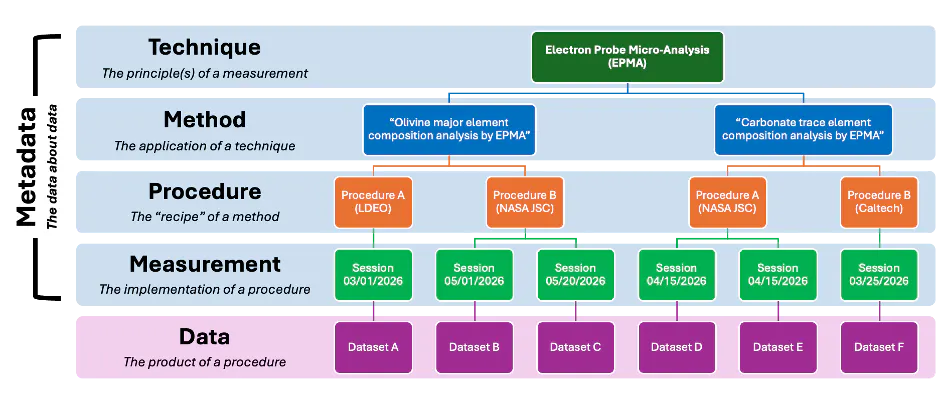
Here is an illustration of the definitions above, using electron probe micro-analysis (EPMA) as an example.
2. How are TAPPs developed?
TAPPs are constructed based on representative procedures reported in peer-reviewed publications, mission reports, datasets, and existing analytical metadata templates (e.g., Auscope Geochemistry Network, EarthChem, Tephra). Agentic AI (Artificial Intelligence) and large language models are utilized for natural language processing of procedure context, metadata extraction, product performance assessment, and file generation. Human experts from relevant technical and scientific communities are involved in each phase of the development to steer the development process, ensure cross-TAPP consistency, and assess profile quality and usability.
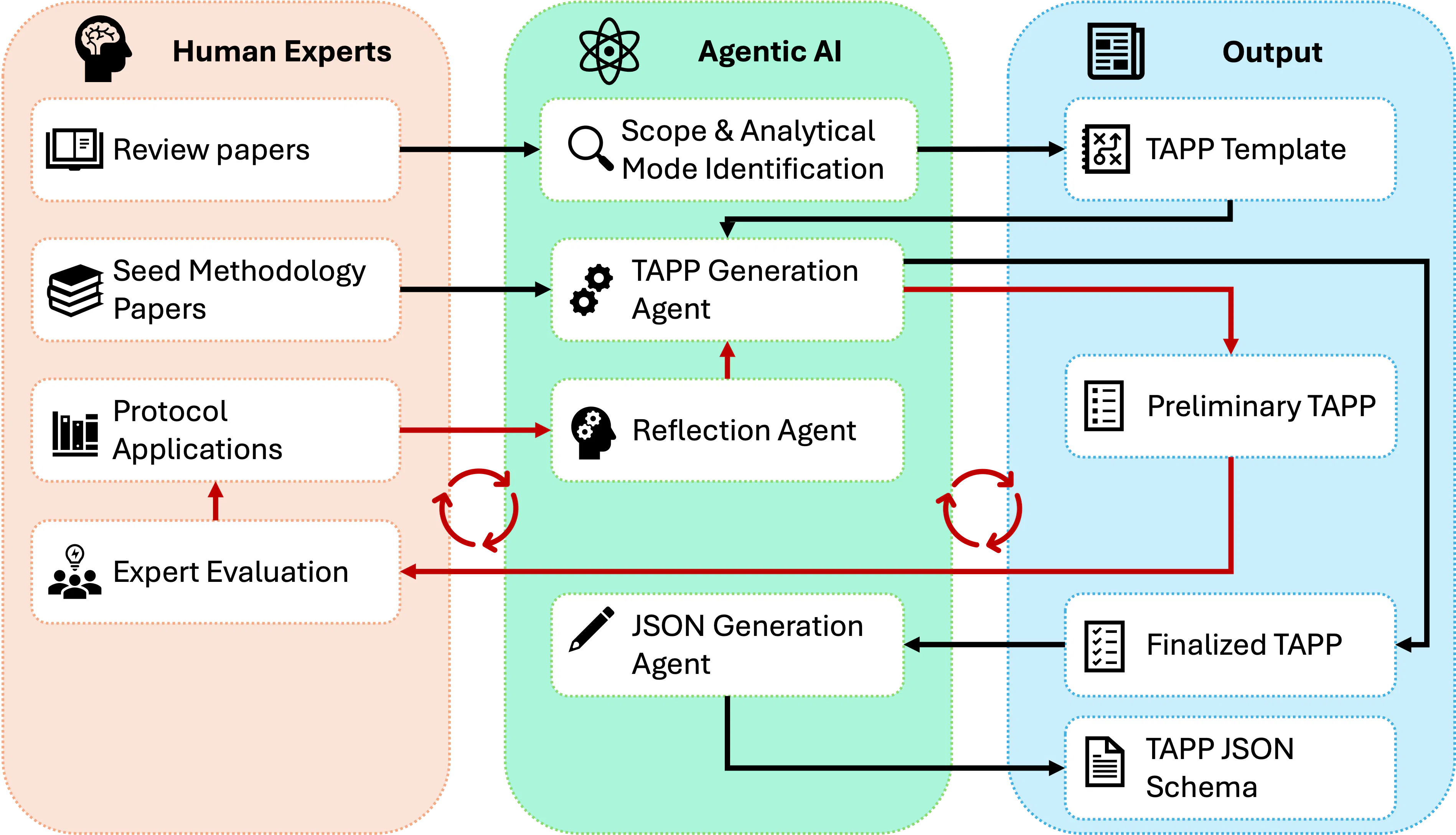
The AI-led, Human-expert-reviewed Development Workflow for TAPPs
3. Who is involved in the development of TAPPs?
TAPP development is sponsored and led by the Astromaterials Data System team at the Lamont-Doherty Earth Observatory of Columbia University, in collaboration with members of the OneGeochemistry Initiatives. During the development, community feedback and input are actively incorporated to ensure profile quality. Experts of techniques are recruited as reviewers to provide thorough and professional evaluations of TAPPs before they are finalized and provided to the community.
4. Can I be a TAPP expert reviewer?
We appreciate your feedback if you:
1. Are interested in contributing your knowledge and expertise to refining TAPPs;
2. Are a regular or experienced user of relevant analytical procedures or the underlying techniques, or demonstrate excellent understanding of the procedures or the underlying techniques.
If you would like to sign up as a TAPP expert reviewer, please fill out this google form with a few simple questions. We will select reviewers based on their experience, background, and fit to specific TAPPs. Once selected, we will contact you through email with a formal review invitation and other information.
5. How will my contribution as a TAPP expert reviewer be acknowledged?
If you are selected as a TAPP expert reviewer, you will by default become a co-author of the TAPP(s) that you are invited to review and relevant publications in peer-reviewed journals, unless: 1. We do not receive your review in time; 2. You elect not to be listed as a co-author.